Customers have started asking an AI assistant for recommendations instead of scrolling through Google. Local business owners want to know whether they can show up in ChatGPT and AI search the same way they show up in the map pack. The short answer is that you can influence it, nobody can guarantee it, and a lot of what is currently sold as AI SEO is guesswork with an invoice attached.
Here is what the measured data actually says, what I do on this site, and what I would not spend a dollar on.
Key Takeaways
- Almost nobody has an llms.txt file: valid
llms.txtfiles appear on 2.10% of mobile sites, which leaves 97.90% of mobile sites without a valid one (HTTP Archive Web Almanac, 2025)- AI crawler names are spreading fast:
gptbotis named in the robots.txt of 4.2% of mobile sites, up from 2.7% in 2024 and described by the researchers as a roughly 55% increase, whileclaudebotrose from 1.6% to 3.4% (HTTP Archive Web Almanac, 2025)- Named is not the same as blocked: that measurement counts a bot as named whether the owner is allowing it, restricting it, or setting a crawl rate, so nobody should read those percentages as a blocking rate.
A note on the numbers below. The Web Almanac measures a crawl of the web at large, not a sample of Ontario local businesses, so read them as the state of the average website rather than a measurement of your competitors.
Can a Local Business Actually Show Up in ChatGPT?
Yes, it happens, and no, nobody can promise it or reliably verify it. An assistant answering “who does emergency plumbing near Mississauga” is pulling from what it absorbed during training plus, in many cases, a live look at the web at the moment you ask. Neither of those is a ranking chart you can check.
That last part is what separates this from ordinary local SEO. With Google you can search your own term, see position 7, and watch it move. With an AI assistant there is no position to see, and the same question asked twice can produce different businesses.
So the useful goal is not a ranking. It is making sure that when one of these systems does go looking, your business is easy to find, easy to read, and says the same thing everywhere.
How Do AI Assistants Find Your Website?
Through crawlers, the same basic way search engines always have. A crawler is an automated program that requests your pages. The file that tells crawlers what they may request is robots.txt, which sits at the root of your site and “specifies whether or not crawlers are allowed access to an entire website, or to specified resources” (MDN, 2026).
What is new is how many of these crawlers now belong to AI companies, or to the AI training programmes of search companies. The Web Almanac tracked how often each one gets named in a robots.txt file:
| Crawler named in robots.txt | Desktop sites | Mobile sites |
|---|---|---|
gptbot |
4.5% | 4.2% |
petalbot |
4.0% | 4.4% |
claudebot |
3.6% | 3.4% |
ccbot |
3.5% | 3.2% |
google-extended |
3.4% | 3.0% |
amazonbot |
3.3% | 3.0% |
facebookbot |
2.9% | 2.5% |
perplexitybot |
2.8% | 2.7% |
chatgpt-user |
2.8% | 2.5% |
meta-externalagent |
2.8% | 2.5% |
Figures from the HTTP Archive Web Almanac, 2025.
Read that table carefully, because it is widely misreported:
- Named does not mean blocked: the Almanac counts a bot as named when “website managers care enough about that crawler to explicitly control its behavior, either allowing it, restricting it, or setting crawl rates” (HTTP Archive Web Almanac, 2025).
- Growth is genuinely steep:
gptbotwent from 2.9% of desktop sites in 2024 to 4.5% in 2025, andclaudebotfrom 1.9% to 3.6%, which the researchers call nearly doubling (HTTP Archive Web Almanac, 2025). - The comparison has a caveat: the Almanac notes that 2024 counted broader categories such as
anthropic-ai, while 2025 tracks more specific bot names, so some of the jump is finer measurement (HTTP Archive Web Almanac, 2025). - Most sites say nothing at all: the catch-all
*is “the most common approach to crawler directives found inrobots.txtfiles today” (HTTP Archive Web Almanac, 2025), so the overwhelming majority of sites have no AI-specific instruction either way.
Different crawlers do different jobs. Some gather pages to train a model, and others fetch a page live when somebody asks a question, which is the one that decides whether you get mentioned today. Anthropic’s documentation for Claude lists “information about specific organizations, people, or products that might have changed” as a trigger for going and looking (Anthropic, 2026), and a question about a local business is exactly that.
That live fetch obeys the same file. Anthropic documents a url_not_allowed error for a page blocked by “Anthropic-side restrictions, such as private addresses and robots.txt” (Anthropic, 2026). If you intend to make a deliberate choice, look up the current behaviour of the specific bot rather than trusting a blog post, because these change.
Should You Block AI Crawlers or Let Them In?
For a local business trying to get found, letting them in is almost always the right call. The Almanac frames the decision well: site owners now have to ask not only “Should this page be indexed for search?” but also “Should this content be used to train AI models?” (HTTP Archive Web Almanac, 2025).
Those are genuinely different questions, and the answer depends on what your website is for. A news site sells its writing, so being absorbed and summarised costs it money. A roofing company’s website is an advertisement, and being summarised to somebody asking about roof repair is the entire point.
Here is the actual robots.txt from the Built to Rank site, in full, so you can copy the shape of it rather than squint at a screenshot:
User-agent: *
Allow: /

User-agent: Googlebot
Allow: /

User-agent: Google-Extended
Allow: /

User-agent: GPTBot
Allow: /

User-agent: ClaudeBot
Allow: /

User-agent: PerplexityBot
Allow: /

User-agent: ChatGPT-User
Allow: /

User-agent: Applebot
Allow: /

Sitemap: https://builttorank.ca/sitemap-index.xml
That spells out five AI-specific agents, Google-Extended, GPTBot, ClaudeBot, PerplexityBot and ChatGPT-User, plus Googlebot and Applebot on the search side. It deliberately does not name every crawler in the table above, because the opening wildcard already allows the rest. Judging by the Almanac numbers, naming any of them puts a site in a small minority.
- Allow by default if you sell services locally: you want to be findable in as many places as a customer might ask.
- Block selectively if content is your product: paid archives, original research and photography libraries are a different business.
- Do not block by accident: a plugin or a host that “protects against AI scraping” may have made this decision for you without saying so, so open your own robots.txt and read it.
- Remember what the file is: robots.txt is an instruction to well behaved crawlers, not a lock on the door. Mozilla warns that “some robots, such as malware robots and email address harvesters, will ignore your
robots.txtfile” and that it “does not secure websites against attackers” (MDN, 2026).
What Is llms.txt and Is It Worth Adding?
It is a proposed standard, not an established one, and the case for adding it is that it is cheap rather than that it is proven. The proposal came from Jeremy Howard in September 2024 and describes “a proposal to standardise on using an /llms.txt file to provide information to help agents use a website” (the llms.txt proposal, updated 2026).
The reasoning behind it is sound. As the proposal puts it, “an HTML page wraps its information in navigation, ads, and JavaScript, and converting it back into clean text is difficult and imprecise” (the llms.txt proposal, updated 2026). An llms.txt file is a plain markdown summary of your site that skips all of that.
The evidence on whether it does anything is thinner:
- Adoption is low: valid
llms.txtfiles were found on 2.13% of desktop sites and 2.10% of mobile sites, a total of 324,184 valid files across the mobile crawl (HTTP Archive Web Almanac, 2025). - Google has said it does not use it: the Almanac records that “Google has often stated that they do not use
llms.txt, and no Google service currently does” (HTTP Archive Web Almanac, 2025). - Anthropic has been more supportive: the same chapter notes Anthropic “has taken a lead” on the format (HTTP Archive Web Almanac, 2025). Read that precisely, because it means Anthropic publishes one for its own documentation, not that it reads yours.
- Many of the files are automatic: 39.6% of them come from All in One SEO and 3.6% from Yoast, and the Almanac concludes it “cannot be sure this is always a conscious act or endorsement” (HTTP Archive Web Almanac, 2025).
That last point is the one nobody quotes. A large share of the 2% is a WordPress plugin generating a file the owner may never have asked for, which makes the adoption figure a weaker signal of belief than it looks.
This site has one, written by hand rather than generated, listing what the business does, real pricing, and the service area:
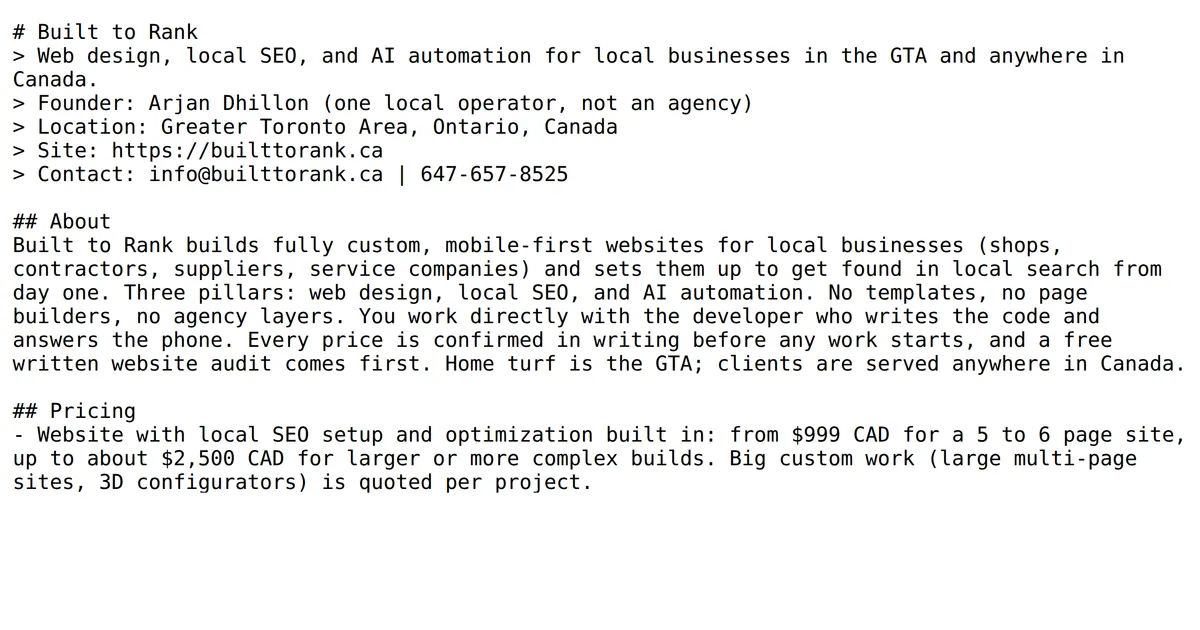
My position on it is unglamorous. It took about twenty minutes, it costs nothing to keep current, I cannot demonstrate that it has ever changed an answer about my business, and I would be annoyed if somebody billed me a monthly fee for it.
Does Your Website Structure Change What AI Can Read?
This is the part that genuinely matters, and it is not new work. Language model systems “extract, summarize, and recombine content” rather than simply ranking pages, which “increases the importance of structure, clarity, freshness, and machine-readable signals” (HTTP Archive Web Almanac, 2025).
The same research is blunt about what makes content hard to use. Pages that “rely heavily on client-side rendering, large JavaScript bundles, or delayed content hydration may be less visible, as extraction becomes slower or incomplete” (HTTP Archive Web Almanac, 2025).
One vendor states the limit outright rather than as a tendency. Anthropic’s documentation says plainly that “the web fetch tool currently does not support websites dynamically rendered with JavaScript” (Anthropic, 2026). If your pages only assemble their text once scripts run, at least one major assistant cannot read them at all.
That is a real argument for keeping a small business site simple:
- Ship plain HTML where you can: this site is a static build, so its words sit in the page source rather than being assembled by scripts after loading, and the same approach carried the larger World Food Equipment build.
- Use headings that state the question: clear hierarchy is easier to extract, and it happens to be better for readers skimming on a phone.
- Keep it current: the same chapter notes these tools “tend to favor content that is regularly updated, clearly attributed, and easy to extract” (HTTP Archive Web Almanac, 2025).
- Add structured data: structured data usage on home pages reached 50% on both desktop and mobile in 2025, up from 48% of desktop and 49% of mobile home pages in 2024, with JSON-LD the dominant format at 43% (HTTP Archive Web Almanac, 2025).
Structured data is the machine-readable summary of who you are and where you work. I have written up the exact markup this site uses, including how to declare a service area without inventing an address, in the guide on ranking in multiple cities.
What Actually Moves the Needle for a Local Business?
The unexciting fundamentals, which is a frustrating answer and a true one. An AI system describing a business is working from what the web says about it, so the job is to make the web say something clear and consistent.
- Google Business Profile first: it remains the strongest local signal and the one customers act on, and it is still where a phone call comes from. Setup and ongoing management is covered on the Google Business Profile management page.
- Consistent details everywhere: the same business name, phone number and service area on your site, your profile and every directory, because contradictions make you harder to describe with confidence.
- Real answers on real pages: a page that plainly answers what you do, where you do it and what it costs is easy for a person and a machine to quote.
- Reviews in your own words and theirs: reviews are read as evidence about your business, and responding to them adds text that describes what you actually did.
- Be mentioned somewhere other than your own site: local directories, suppliers, associations and press give an assistant something to corroborate.
- Fix the boring technical faults: if a page cannot be crawled or is too slow to load, none of the rest applies. I walk through those checks in why your website is not showing up on Google.
Notice that every one of these is something you would do anyway for local SEO. That is the real headline of this whole subject: there is no separate AI channel to buy, and the work overlaps almost entirely with getting found normally.
What Should You Refuse to Pay For?
Anything sold on a promise nobody can keep or measure. This market is new enough that confident claims are cheap to make and nearly impossible for a business owner to check, which is exactly the condition that produces bad invoices.
- Guaranteed ChatGPT rankings: there are no published positions to guarantee, so the guarantee is unfalsifiable by design.
- AI rank tracking dashboards: an assistant can answer the same question differently twice, so a chart of your “AI position” is a chart of noise.
- A monthly fee for an llms.txt file: it is a text file that takes twenty minutes, and Google has said it does not use it.
- Bulk AI written pages to “feed the machines”: thin duplicated pages were a bad idea when only search engines read them, and nothing about that has changed.
- A second AI optimised website: the fundamentals of a fast readable site serve both audiences, so this is a proposal to sell you a second site.
If someone wants to sell you AI visibility, ask a simple question: what will you show me at the end of the month that proves this worked? A straight answer sounds like clearer pages, better structured data and a tidier profile. A vague one is a sign to keep your money.
Frequently Asked Questions
Can I pay someone to rank my business in ChatGPT?
No, and be careful with anyone who offers to. There is no ranking system to buy into, no published positions, and no way for a seller to prove they moved you. What a competent person can do is make your site easy to fetch and read and your business details consistent everywhere, which is worth paying for, while a guaranteed position is not.
Does adding an llms.txt file help my business show up in AI answers?
Nobody can currently prove that it does, and Google has stated it does not use llms.txt. No reliable way exists to measure whether the file changed an answer about your business, though it takes about twenty minutes to write and does no harm, so I keep one on this site. Treat it as a cheap experiment rather than a service worth being billed for.
Should I block AI crawlers from my website?
For most local businesses trying to get found, no. Blocking an AI crawler removes one more way a customer can be pointed to you, and a plumber or a shop has little to protect from being summarised. Publishers who sell access to their writing face a genuinely different decision, because their content is the product rather than an advertisement for it.
How do I know if anyone is finding me through ChatGPT?
Mostly you cannot, and that is the plain state of it right now. Search Console reports Google Search, not AI assistants, and analytics rarely shows a clean referral from a chat interface. The practical workaround is to ask new customers how they found you and write the answers down, which is the same low tech method that worked before any of this existed.
Is AI search replacing Google for local businesses?
Not for the kind of searches that produce local jobs. Somebody who needs a roof leak fixed today still reaches for the map and the phone. Treat AI visibility as an additional way to be found rather than a replacement for your Google Business Profile, which is still where local buying decisions get made.
Do I need a special AI version of my website?
No. What makes a page easy for an AI system to read is what makes it easy for a search engine and a customer: fast loading, clear headings, real answers in normal words, and accurate details about what you do and where you work. If somebody proposes a separate AI site, they are selling you a second website.
Wrapping Up
The genuinely useful finding in the current data is how early all of this is. About two percent of sites have a valid llms.txt, that adoption figure is inflated by plugins, Google says it does not use it, and there is still no way to check your position in an answer engine.
What has not changed is the work. A fast site made of real HTML, headings that answer questions, accurate structured data, a filled out Google Business Profile and consistent details across the web are what make a business easy to describe. That is true whether the thing describing it is a search engine or an assistant.
If you want to know where your site actually stands on those fundamentals before spending anything on AI visibility, get a free website audit and I will tell you what is worth fixing first.
Further reading: