Ask three Ontario web designers what a website costs and the quotes can come back at $500, $5,000 and $25,000 for what sounds like the same job. That spread is not proof anyone is ripping you off. Website design cost is driven almost entirely by scope, and almost nobody publishes their numbers, so owners are asked to judge quotes with nothing to compare them against.
This guide fixes the second half of that problem. It puts real Ontario numbers on the page, including mine, then explains what actually moves the price up and how to read a quote before you sign it.
Key Takeaways
- A 5 to 6 page small business website in Ontario with local SEO setup included starts at $999 CAD at Built to Rank, with larger builds up to about $2,500
- The platform is rarely what you are paying for: over half the crawled mobile web already runs on a CMS, and most of that is WordPress (HTTP Archive Web Almanac, 2025)
- Only 48% of sites passed Core Web Vitals on mobile in 2025, up from 44% in 2024, meaning more than half the web is measurably too slow (HTTP Archive Web Almanac, 2025)
- The three questions that explain almost every price gap: how many pages, who writes the content, and is search setup included
Every web-wide figure in this post comes from a single source, the HTTP Archive Web Almanac, which crawls millions of real public websites each year and publishes its methodology. Every price is Built to Rank’s own published rate.
What Does a Small Business Website Cost in Ontario in 2026?
From the quotes I have written and the ones Ontario owners have brought me to compare, most small local businesses land between roughly $1,000 and $2,500 CAD for a professionally built website. Below that you are usually buying a template with your logo dropped into it. Above it you are usually paying for custom functionality, a much larger page count, or an agency’s overhead rather than a better website.
Here is what Built to Rank charges, published in full. You cannot judge a quote without a reference point, and most of this industry refuses to give you one.
| What you are buying | Price (CAD) | What it covers |
|---|---|---|
| 5 to 6 page website | From $999 | Custom mobile-first build, local SEO setup and optimization included |
| Larger website | Up to about $2,500 | More pages: service pages, city pages, project galleries |
| Custom build | Quoted per project | Large multi-page sites, 3D configurators, custom web apps |
| SEO retainer | $300/mo | Ongoing optimization, monitoring and new content |
| SEO plus ads management | $600/mo | Adds Google and Meta Ads management |
| Full stack retainer | $1,000/mo | Adds HubSpot CRM and social media management |
| Google Business Profile management | $250/mo flat | Profile posts, photos, Q&A, review monitoring |
| Social media management | $300/mo flat | Content planning and posting |
Two things about that table matter more than the numbers. Every retainer is optional and month to month, and the website is yours whether you take one or not. Full detail sits on the services and pricing page.
What Are You Actually Paying For When You Buy a Website?
You are paying for decisions and hours, not for code by the pound. The visual design is a smaller slice of the budget than most owners expect. On a small business build, most of the money goes into structure, writing, and the setup that decides whether Google can understand the site at all.
- Discovery and structure: which pages exist, what each one has to do, and what a customer needs to see before they will call you.
- Copywriting: the actual words on every page, which is usually the single biggest time cost and the first thing a cheap quote quietly hands back to you.
- Design and build: layout, brand application, and building it mobile-first rather than shrinking a desktop design down.
- Local SEO setup: page titles, descriptions, heading structure, schema markup and internal linking, done during the build instead of bolted on later.
- Testing on real phones: checking the site at a 375px width, not just in a desktop browser window made narrow.
- Launch and handover: domain and hosting configuration, analytics, Search Console, and making sure you can actually get into your own accounts.
Why Do Two Quotes for the Same Website Differ by Thousands?
Because they are almost never quotes for the same website. A six-page template build with stock photos and content you supply, and a twenty-page site with original copywriting and a real search structure, are different products that happen to share a name. Both quotes can be completely honest.
Five variables explain nearly every gap you will see:
- Page count: a site with one page per service and per city is several times the work of a five-page brochure, because each page needs its own writing and its own search target.
- Who does the work: a one-person operator carries no account managers, no sales team and no office, and that difference shows up in the quote rather than in the finished site.
- Where the content comes from: “content supplied by client” is the most expensive four words in a cheap quote, because most owners never supply it and the site launches half empty.
- Whether search setup is included or extra: some builds are priced with no SEO at all, then the SEO is sold to you afterwards as a second project.
- Custom functionality: anything a visitor interacts with beyond reading and clicking is real software, and it is priced like software.
Which Features Push a Website Design Cost Up the Most?
Custom functionality, page count and original content, roughly in that order. A standard brochure site is a solved problem. The moment your site has to do something specific to your business, the quote stops being a list price and becomes a project.
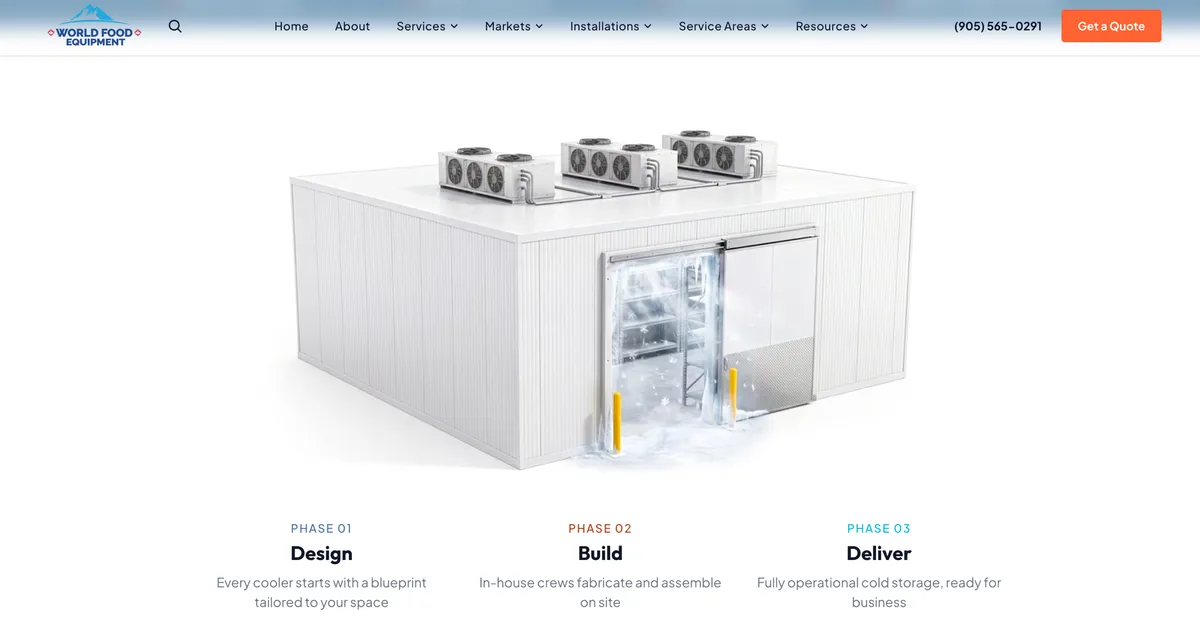
- Interactive tools: a configurator, calculator or map is custom development. On the World Food Equipment build, a Mississauga commercial refrigeration company in business since 1995, no photo set could show every walk-in cooler configuration, so I built a Three.js 3D configurator that lets the customer spec their own box.
- Large page counts: that same build runs past 40 pages, one per service, industry and service area, because that is what it takes to have an answer ready for every relevant search.
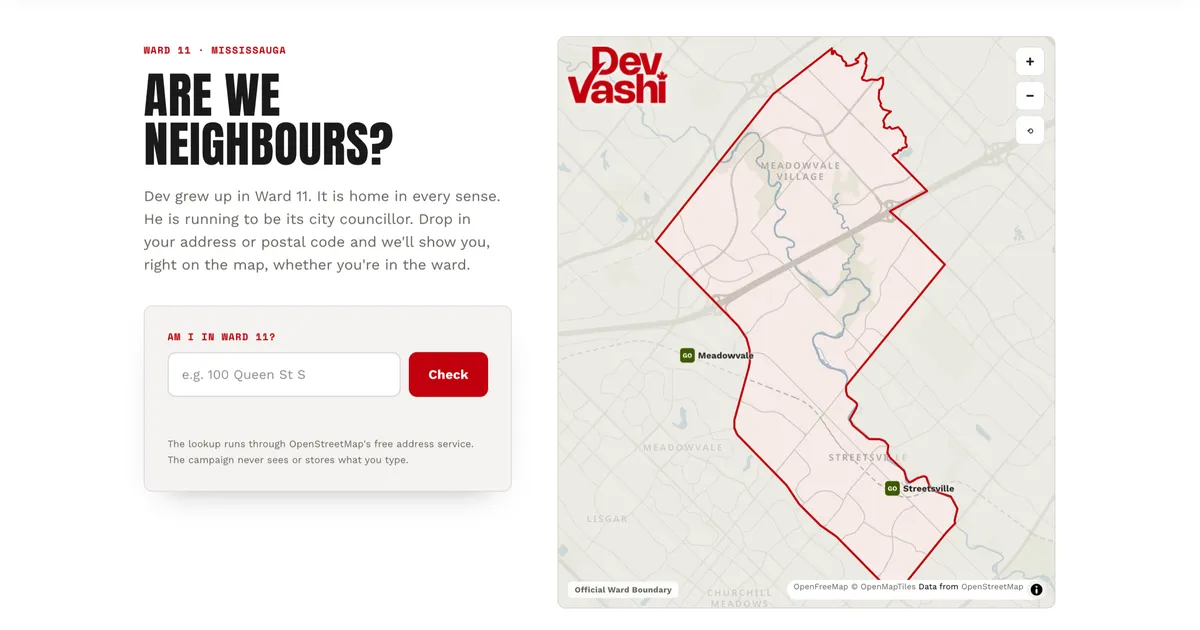
- Custom mapping and lookups: I built an interactive Ward 11 map for the Dev Vashi campaign site so a resident could check their own address before volunteering.
- Brand work from scratch: a logo and brand kit is its own project. The Vashi campaign started with identity first and the website second.
- E-commerce and booking: payments, inventory and scheduling each add moving parts that have to be tested, secured and maintained.
- System integrations: connecting a site to a CRM or to AI automation is worth doing, and it is not part of a base website price.
Is a DIY Website Builder Cheaper Than Hiring Someone?
Cheaper in cash, rarely cheaper once you count your own hours. A builder subscription is a small monthly fee, and for a placeholder site that is the right call. What the subscription does not cover is the writing, the photography, the structure and the search setup, which are the parts that decide whether the site ever produces a phone call.
The platform itself is rarely the differentiator. CMS-driven sites account for over 54% of websites crawled on mobile, and WordPress alone powers roughly 64% of those (HTTP Archive Web Almanac, 2025). Nobody at this end of the market is inventing anything from scratch, which means what you are actually buying is judgment about setup and structure.
Where the platforms genuinely separate is speed, and the result cuts against the most popular choice. Among sites detected on each platform, 85% of Duda sites and 74% of Wix sites pass Core Web Vitals, against 45% of WordPress sites (HTTP Archive Web Almanac, 2025). Around 60% of WordPress sites run a page builder (HTTP Archive Web Almanac, 2025), which is one plausible reason.
The real test is what you want the site to do. If it exists so people can confirm you are real, build it yourself and spend the money on your Google Business Profile instead. If it has to compete for searches against companies who paid someone, DIY is usually the more expensive route with extra steps.
What Does a Cheap Website Cost You Later?
The bill for a cheap build arrives late, in speed, in search visibility, and eventually in a rebuild you did not plan for. None of it shows up on launch day, which is exactly why the cheap quote keeps winning.
Speed comes first, because it is measurable. Only 48% of sites passed Core Web Vitals on mobile in 2025, up from 44% in 2024 and 36% in 2023 (HTTP Archive Web Almanac, 2025). More than half the web is too slow by Google’s own threshold, and the budget end of the market is well represented in that half.
Page weight is why: the median mobile home page reached 2.6 MB in 2025, up 8.4% in a single year. Median image weight alone is 911 KB, and median JavaScript another 632 KB (HTTP Archive Web Almanac, 2025). Mobile also trails desktop on the metric your customers actually feel, load speed: 74% of desktop pages achieve a good Largest Contentful Paint, compared to 62% on mobile (HTTP Archive Web Almanac, 2025).
Then there is search visibility, where a cheap build costs you quietly and for years. Only 67.2% of mobile pages carry a meta description, just 50% of pages contain any structured data at all, and at the median page only 60% of images have an alt attribute (HTTP Archive Web Almanac, 2025). None of that is advanced work; it is the cheap part, and most sites skip it.
The contact form is where the shortfall costs you a lead directly. Only 35% of mobile form inputs get an accessible name from a real label, and 55% rely on placeholder text alone (HTTP Archive Web Almanac, 2025). A form that a phone cannot fill in properly is a lead that never reaches your inbox.
The pattern is consistent enough to plan around. If a site fails on one of those fronts it can usually be patched, and if it fails on several then patching is money spent on a foundation problem. That is the calculation behind what a trades website must have: the cheap site rarely stays cheap, it just moves the cost somewhere you were not looking.
What Does a Website Cost to Run Every Year?
Less than most owners fear, as long as nobody is charging you rent on your own site. The recurring costs split into two groups: the small unavoidable ones, and the optional marketing spend that is genuinely a separate decision.
Maintenance is the line owners underestimate, and the evidence says most sites are under-maintained rather than over-serviced. A quarter of mobile websites use no caching at all (HTTP Archive Web Almanac, 2024), and only 21.9% of sites use a Content Security Policy (HTTP Archive Web Almanac, 2025). These are set-once items that quietly stay unset.
- Domain renewal: an annual charge and almost always the smallest line on the list.
- Hosting: cheap for a small static business site. This site runs on Cloudflare Pages, which is the same class of hosting I put client builds on.
- Maintenance and updates: keeping software current, fixing what breaks, and making the small copy changes a growing business needs. Detail on the website maintenance page.
- SEO or ads retainer: optional, month to month, and the only line here that is really a marketing budget rather than an operating cost.
- The line to watch: a monthly fee that keeps your site online but gives you nothing back if you leave. Ask what happens to the website the month you stop paying.
How Do You Tell a Fair Quote From a Bad One?
A fair quote is specific enough that you could hand it to a second designer and get a comparable number back. A bad quote is a single figure with a one-line description, and the vagueness is usually where the disagreement is going to happen later.
Run every quote you get through this list:
- It is in writing: a verbal number is not a quote, and a written scope is what you will both be reading when something is disputed.
- It names the page count: “a website” is not a scope. “Seven pages, listed by name” is.
- It says who writes the content: if the answer is you, add your own hours to their price before comparing.
- It states whether search setup is included: and if it is, what specifically, because “SEO ready” means nothing on its own.
- It says who owns what: the domain, the hosting account and the site itself should end up in your name, in writing.
- It explains the ongoing cost before you sign: any monthly fee should be named up front, not introduced after launch.
- It follows an actual look at your current site: a number quoted before anyone has looked at what you already have is a guess dressed as a price.
A deposit up front is normal and not a warning sign. What should give you pause is a quote that cannot answer the questions above, or one where the price only makes sense if you never ask what is inside it.
The full list of what to ask before you sign, including who ends up holding the domain and the logins, is in the post on questions to ask a web designer.
If you want more than one quote to compare, agency directories like DesignRush list web designers by service and location. Get at least two written quotes and run both through the list above.
Frequently Asked Questions
How much does a website cost in Ontario for a small business?
From the quotes I have written and the ones Ontario owners have brought me to compare, most small local businesses land between roughly $1,000 and $2,500 CAD. At Built to Rank a 5 to 6 page site with local SEO setup and optimization included starts at $999 CAD, and larger builds run up to about $2,500. Anything with custom functionality, like a configurator or a booking system, is quoted per project because the work varies too much to price off a list.
Why do some web designers charge $500 and others charge $10,000?
Because they are almost never quoting the same website: a $500 quote is usually a template with your logo dropped in and content you write yourself. A $10,000 quote usually includes original copywriting, custom design, a much larger page count, and often an agency’s overhead. Ask both quotes for a page count, a named content owner, and a yes or no on search setup.
Is it cheaper to build my own website?
Cheaper in cash, rarely cheaper overall. A builder subscription costs less than a build, but you supply the time, the writing, the photos, and the search setup, and those are the parts that decide whether the site brings in calls. DIY makes sense when the site is a placeholder, and stops making sense the moment you need it to actually find you customers.
Do I have to pay monthly for a website after it is built?
Not for the website itself. You will always have a domain renewal and hosting, and hosting for a small static business site is genuinely cheap. A monthly retainer for SEO or ads is optional and separate: my retainers start at $300/mo CAD, run month to month, and the site is yours whether you take one or not.
Does the price of a website include SEO?
It depends entirely on the quote, which is why you have to ask. Plenty of builds are priced without any search setup, then sold the SEO afterwards as a separate project. I put the local SEO setup and optimization inside the build price, because retrofitting structure into a finished site costs more and works worse than doing it once.
Who owns the website when it is finished?
You should, and you should see that in writing before you pay a deposit. Ask specifically who holds the domain registration, who has the hosting account, and whether you keep the site if you stop working together. If a quote is vague about ownership, treat that as a pricing question, because a site you cannot take with you is worth less than one you can.
Wrapping Up
The reason website design cost feels impossible to judge is not that the work is mysterious. It is that the industry treats its pricing as a negotiating position, so owners get numbers with no scope attached and are expected to pick one.
You do not need to become an expert to buy well. Get the page count, the content ownership and the search setup written down, compare quotes on those three lines instead of the total, and the spread between a $500 site and a $5,000 site stops looking like a mystery and starts looking like a specification.
If you want a straight number for your own business, get a free website audit from Built to Rank. I will look at what you have now, tell you whether it needs a rebuild or just fixing, and put a real price in writing, whether you are in Peel Region, the wider GTA, or anywhere else in Canada.
Further reading: